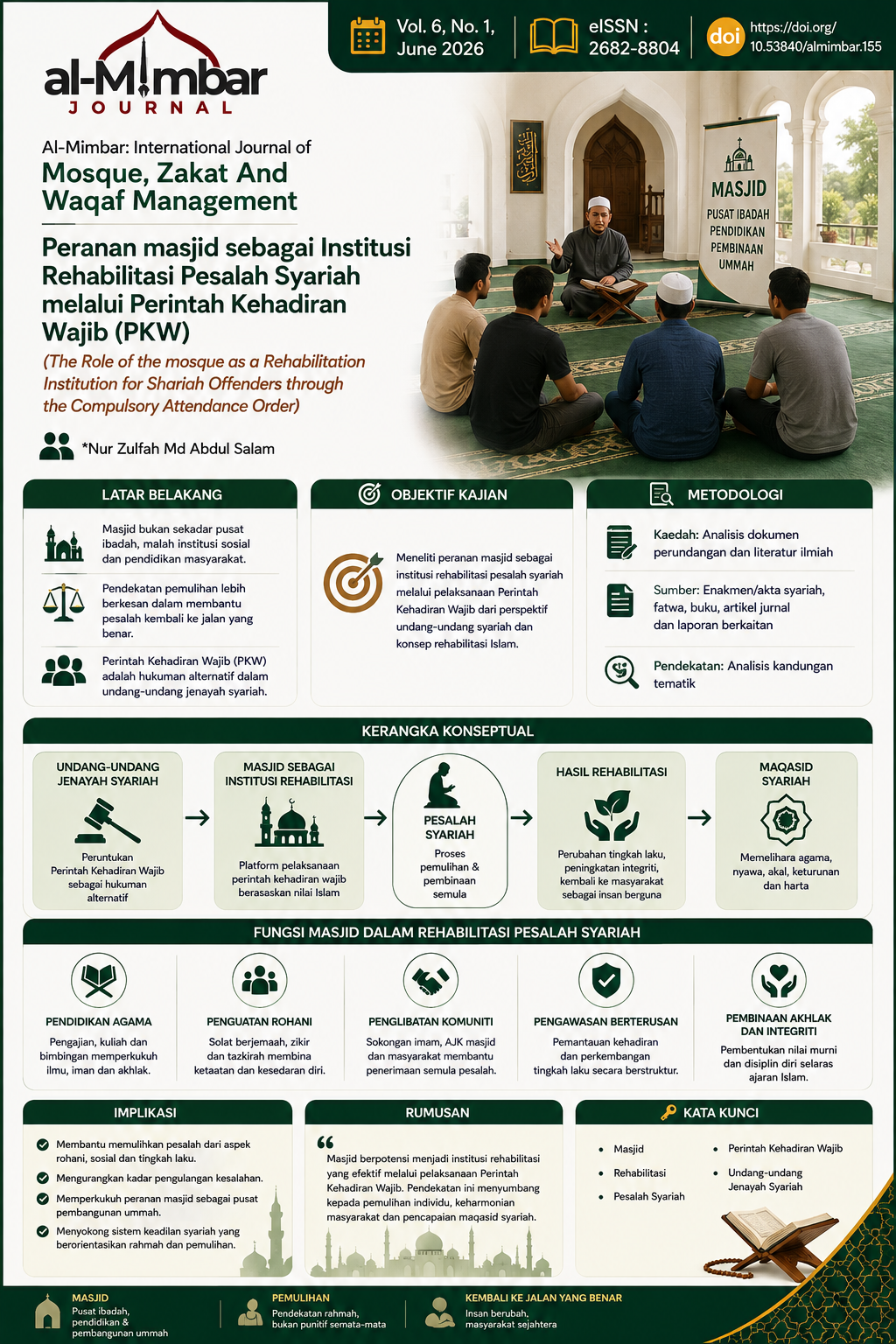
Peranan masjid sebagai Institusi Rehabilitasi Pesalah Syariah melalui Perintah Kehadiran Wajib (PKW)
The Role of the mosque as a Rehabilitation Institution for Shariah Offenders through the Compulsory Attendance Order
DOI:
https://doi.org/10.53840/almimbar.155Keywords:
Masjid, Rehabilitasi, Syariah, Perintah Kehadiran Wajib, Undang-undang Jenayah SyariahAbstract
ABSTRACT
A mosque in Islam is not merely a center of worship, but also plays a role as a social and educational institution for the community. This article discusses the role of the mosque as a medium for the rehabilitation of Shariah offenders through the implementation of the Compulsory Attendance Order (CAO). This order is a form of alternative sentencing in Shariah criminal law that emphasizes a rehabilitative approach rather than a purely punitive one. This study examines the legal framework that provides for this order, the concept of rehabilitation from a Shariah perspective, and the function of the mosque in reshaping the morals and spiritual integrity of the offenders. Using methods of legal document analysis and scholarly literature, this article finds that the mosque is capable of being an effective platform in guiding offenders back to the right path through religious education, community involvement, and continuous supervision. The implications of the study indicate that the implementation of the Compulsory Attendance Order at mosques not only contributes to the rehabilitation of the individual but also strengthens the role of the mosque as a center for community development in line with the objectives of Shariah (maqasid shariah).
Keywords: Mosque, Rehabilitation, Shariah Offender, Compulsory Attendance Order, Shariah Criminal Law, Maqasid Syariah
References
Hisham, R.B. (2014). Kertas Kerja: Keberkesanan Konsep Pemulihan dan Keadilan Restoratif dalam Hukuman. Seminar Undang-Undang dan Masyarakat II: Menambahbaik Pentadbiran Keadilan Jenayah Syariah di Malaysia pada 3 April 2014 bertempat di Auditorium Perpustakaan Universiti Islam Antarabangsa Malaysia.
Rahman, A., & Fauzi, M. (2017). Performance measurement of mosques based on Maqasid Al-Syariah in Malaysia: governance of resources, processes and outputs/Muhd Fauzi Abd. Rahman (Doctoral dissertation, Universiti Teknologi MARA (UiTM)).
Sahad, M. N., Suhaila, A., & Yusuff, S. (2022). Mosques’ Management Model in Indonesia and Malaysia: A Systematic Literature Review. International Journal of Academic Reserach in Economics and Management Sciences, 11(3).
Shahbuddin, Z. H. S., & Gunardi, S. (2023). Tinjauan Literatur Sistematik Terhadap Peranan Institusi Masjid di Malaysia: Systematic Literature Review (SLR) on The Role of Mosque Institutions in Malaysia. ‘Abqari Journal, 29(1), 54-71.
Sharif, M. F. M., Akhir, N. S. M., Khalli, M. N. M., & Bakar, N. A. (2024). Masjid sebagai Hab Kebajikan Masyarakat serta Sinergi Dakwah di Malaysia dan Aceh. Islamiyyat, 46(2), 167-178.
Akta Mahkamah Syariah (Bidang Kuasa Jenayah) 1965 (selepas ini disebut sebagai Akta 355)
Enakmen Tatacara Jenayah Syariah (Negeri Selangor ) 2003
Enakmen Jenayah Syariah (Negeri Selangor) 1995.
Downloads
Published
Issue
Section
How to Cite