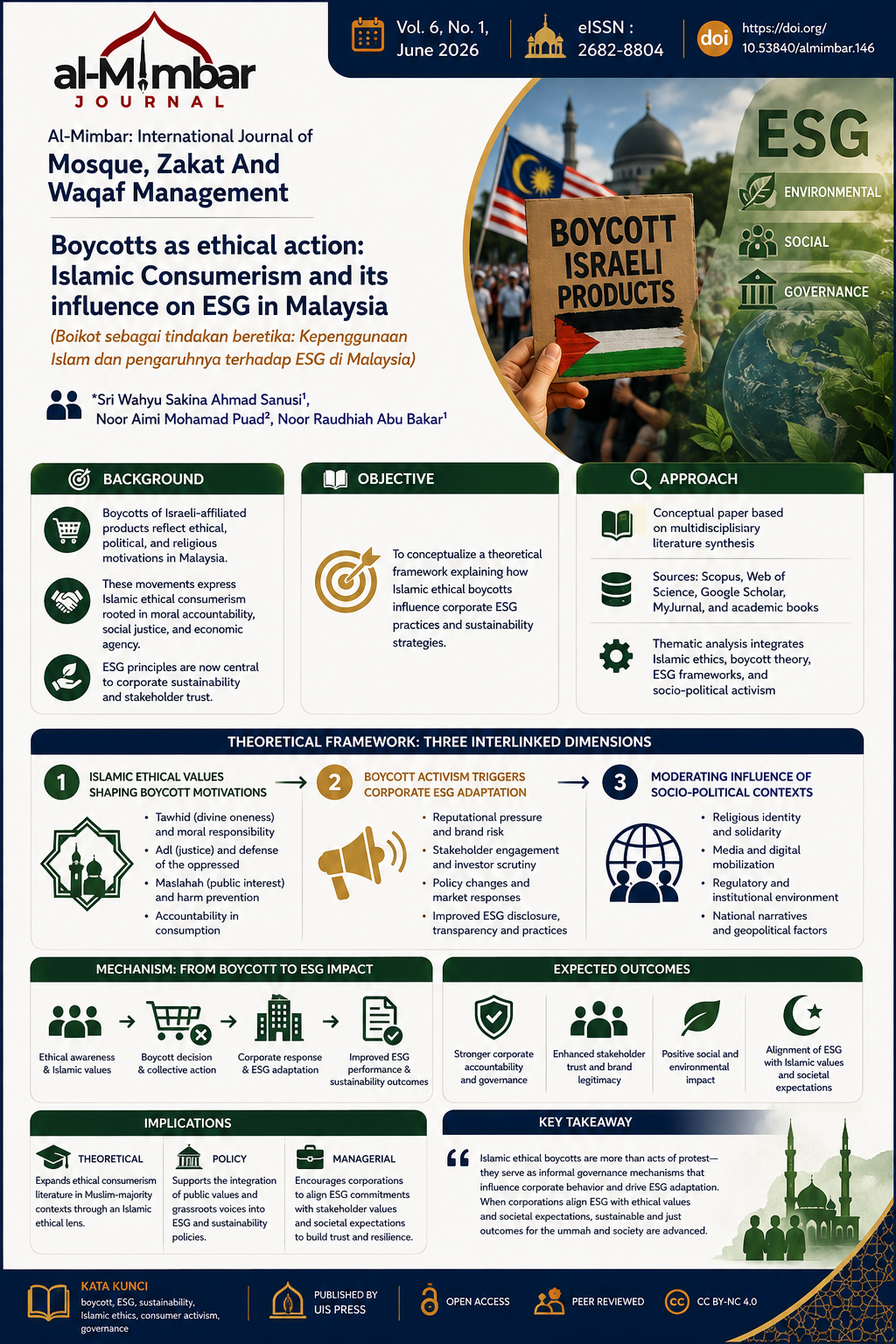
Boycotts as ethical action: Islamic Consumerism and its influence on ESG in Malaysia
Boikot sebagai tindakan beretika: Kepenggunaan Islam dan pengaruhnya terhadap ESG di Malaysia
DOI:
https://doi.org/10.53840/almimbar.146الكلمات المفتاحية:
boycott، ESG، sustainability، Islamic ethics، consumer activism، governanceالملخص
ABSTRACT
Boycotts particularly those directed at Israeli-affiliated products have emerged as a compelling form of collective consumer activism driven by ethical, political, and religious motivations. In the Malaysian context, such movements transcend mere political symbolism, embodying an expression of Islamic ethical consumerism that intertwines moral accountability, social justice, and economic agency. Concurrently, Environmental, Social, and Governance (ESG) principles have become integral to corporate sustainability, shaping how organizations demonstrate responsibility, transparency, and stakeholder trust. This conceptual paper explores the intersection between Islamic ethical boycotts and ESG practices, proposing a theoretical framework that explains how values-based consumer activism can operate as an informal governance mechanism influencing corporate behaviour and sustainability strategies. Rather than presenting empirical findings, the study synthesizes multidisciplinary literature across Islamic ethics, consumer boycott theory, ESG frameworks, and socio-political activism to advance an integrated understanding of how ethical consumer movements shape corporate governance and strategic responses. The proposed framework illustrates three interlinked dimensions: (1) the role of Islamic ethical values in shaping boycott motivations, (2) the capacity of boycott activism to trigger corporate ESG adaptation, and (3) the moderating influence of national socio-political contexts. By articulating these connections, this paper contributes to the growing discourse on ethical consumerism in Muslim-majority societies and offers actionable insights for corporations seeking to align ESG commitments with stakeholder values and societal expectations. The conclusion highlights theoretical, policy, and managerial implications while suggesting pathways for future empirical validation.
Keywords: boycott, ESG, sustainability, Islamic ethics, consumer activism, governance
المراجع
Bakri, A., Zakaria, I. H., Kassim, R., & Ahmad, A. N. A. (2018). Adoption of the Systematic Facilities Management Approach to the Sustainable Performance of Mosques. International Journal of Technology, 9(8), 1542-1550. https://doi.org/10.14716/ijtech.v9i8.2745
Basit, A. (2009). Strategi Pengembangan Masjid Bagi Generasi Muda. KOMUNIKA: Jurnal Dakwah dan Komunikasi, 3(2), 270-286. https://doi.org/10.24090/komunika.v3i2.130
Hamidi, K. A., & Mustafa, Z. (2013). Politik Gender: Perbandingan Peranan Wanita dan Proses Politik di Malaysia-Jepun: Halangan dan Prospek. E-Journal of Social Science Research.
Muhyiddinn, A. D., & Ridouan, A. (2020). Peranan Ahli Kariah Masjid Dalam Mengimarahkan Aktiviti-Aktiviti Masjid: Satu Kajian di Masjid Taman Bukit Bendera, Mentakab Pahang Darul Makmur. Al-Sirat, 19, 117-134.
Mustari, M. I., & Jasmi, K. A. (2008). Fungsi dan Peranan Masjid dalam Masyarakat Hadhari. Kuala Lumpur: Penerbit UiTM.
Muttaqin, A. I., & As'adi, M. (2019). Pendampingan Kegiatan Keagamaan di Masjid Al Falah Dusun Krajan Desa Siliragung Kecamatan Siliragung Banyuwangi. Jurnal ABDI KAMI (Jurnal Pengabdian kepada Masyarakat), 1(2), 105-114.
Norani, M. N. M., & Abdullah, W. H. (2020). Analisis Aktiviti Pengajian Keagamaan di Institusi Masjid-Masjid Negeri Melaka. BITARA International Journal of Civilizational Studies and Human Sciences, 3(1), 119-129.
Nurdin, Z. (2019). Shalat Tarawih Bagi Perempuan di Masjid Era 4.0. Nuansa, 12(2), 268-277. https://doi.org/10.29300/nuansa.v12i2.2764
Nurhakki, N., & Haq, I. (2017). Representasi Perempuan di Masjid. Jurnal Askopis, 1(2), 81-88. https://doi.org/10.32494/ja.v1i2.31
Nyhagen, L. (2019). Mosques as Gendered Spaces: The Complexity of Women's Compliance with, and Resistance to, Dominant Gender Norms, and the Importance of Male Allies. Religions, 10(5), 1-15. https://doi.org/10.3390/rel10050321
Omar, A. R. C., Hussin, M. Y. M., & Muhammad, F. (2019). Assessing Strategic Orientation and Mosques Performance. Research in World Economy, 10(5), 30-35. https://doi.org/10.5430/rwe.v10n5p30
Priyono, D. J., Fawaidi, B., & Nurhayati, U. (2020). Pemberdayaan Masjid: Pembinaan Masjid Agar Menjadi Masjid yang Makmur di Masjid Al-Huda Dusun Darussalam Desa Jatimulyo Kecamatan Jenggawah Kabupaten Jember. Al-Ijtima' Jurnal Pengabdian kepada Masyarakat, 1(1), 26-40.
Remly, M. R., Abdul Kadir, M. N., Othman, F., & Sabaruddin, S. A. (2019). Prinsip al-Imarah dalam Kalangan AJK Masjid ke Arah Mengimarahkan Institusi Masjid. Jurnal Al-Turath, 4(2), 28-36.
Saari, C. Z., & Borhan, J. T. (2006). Peranan Wanita dalam Pengukuhan Akidah Umat Islam. Jurnal Usuluddin, 23, 35-50.
Salleh, S. F. (2011). Muslimah dan Masjid dari Perspektif Aktiviti Ibadah. Jurnal Islam dan Masyarakat Kontemporari, (Keluaran Khas), 71-81.
Soetrisno, L. (2016). Peranan Wanita dalam Pembangunan: Suatu Perspektif Sosiologis. Populasi. https://doi.org/10.22146/jp.10692
Ufiana. (2016). Efektivitas Dakwah Muslimat NU di Desa Nyamuk Kecamatan Karimunjawa Kabupaten Jepara. Jurnal An-Nida, 8(1), 83-92.
Utaberta, N., & Othman, H. (2012). Analisis Hadits dalam Permasalahan Perancangan Masjid Modern di Malaysia. Journal of Islamic Architecture, 1(3), 107-122. https://doi.org/10.18860/jia.v1i3.1770
Zairul, M. (2020). A Thematic Review on Student-Centred Learning in the Studio Education. Journal of Critical Reviews, 7(2), 504-511. https://doi.org/10.31838/jcr.07.02.95
التنزيلات
منشور
إصدار
القسم
كيفية الاقتباس