Model Tadbir Urus Tauliah Mengajar di Perlis: Analisis konseptual terhadap pelaksanaan, pengukuhan dan pengembangan ilmu
Governance Model of Teaching Accreditation in Perlis: A conceptual analysis of implementation, strengthening and knowledge development
DOI:
https://doi.org/10.53840/almimbar.153Keywords:
Islamic Governance, Teaching Accreditation, Knowledge Development, PerlisAbstract
ABSTRACT
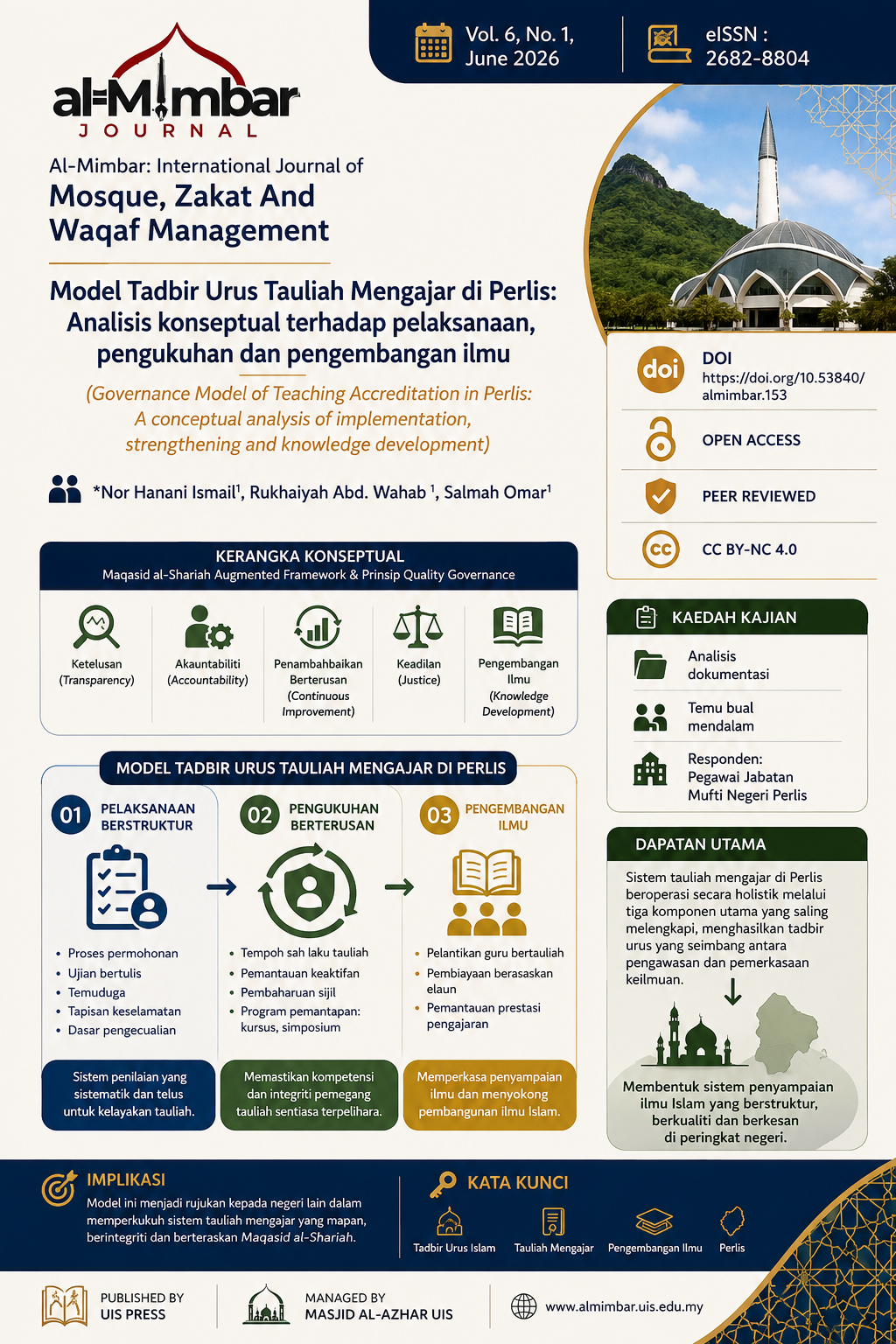
This study presents a conceptual analysis of the governance model for teaching accreditation (tauliah mengajar) in the state of Perlis, focusing on three core components: implementation, strengthening, and knowledge development. The analysis is grounded in the Maqasid al-Shariah Augmented Framework (Mergaliyev et al., 2019) and the principles of quality governance in Islamic education, which emphasise transparency, accountability, and continuous improvement. The methodology employed includes document analysis and an in-depth interviews with officers from the Perlis State Mufti Department to examine the procedures for implementing teaching accreditation, reinforcement mechanisms, and knowledge development initiatives among accredited teachers. The findings reveal that the teaching accreditation system in Perlis operates through three foundational pillars: (i) Structured implementation, encompassing application procedures, written assessments, interviews, security screening, and exemption policies; (ii) Continuous strengthening, through validity periods, monitoring of teaching activity, certificate renewal, and capacity-building programmes such as courses and symposiums; and (iii) Knowledge development, through the appointment of accredited teachers, an allowance-based financing structure, and periodic evaluation of teaching performance. Perlis’ openness to candidates from formal, non-formal, and international educational backgrounds reflects a governance model that balances regulatory oversight with the empowerment of scholarly competence. This study proposes a conceptual governance model for teaching accreditation that emphasises equilibrium between implementation, strengthening, and knowledge development as the basis for a structured, high-quality, and effective system of Islamic knowledge dissemination at the state level.
Keywords: Islamic Governance, Teaching Accreditation, Knowledge Development, Perlis
References
Braun, V., & Clarke, V. (2006). Using thematic analysis in psychology. Qualitative Research
in Psychology, 3(2), 77–101. https://doi.org/10.1191/1478088706qp063oa
Ibrahim, M. Y. (2019). The religious tolerance practice by maqasid syariah. International
Research Journal of Shariah Muamalat and Islam, 1(2), 1–10. https://doi.org/10.35631/irjsmi.12001
Jabatan Mufti Negeri Perlis. (2024). Prosedur tauliah mengajar dan ceramah agama di
masjid Negeri Perlis. Retrieved from https://muftiperlis.gov.my
Jami, D. Z., & Muharam, A. (2022). Strategy for improving the quality of Islamic religious
education study programs with total quality management. Nidhomul Haq: Jurnal Manajemen Pendidikan Islam, 7(2), 267–281. https://doi.org/10.31538/ndh.v7i2.2096
Komsiyah, I. (2021). Implementation of internal quality assurance to improve the quality of
Islamic education. AL-ISHLAH: Jurnal Pendidikan, 13(3), 2241–2251. https://doi.org/10.35445/alishlah.v13i3.1341
Mahmod, Z., & Buang, A. H. (2021). Professionalism of Syariah judges of Syariah courts
according to the perspective of Islamic law. International Journal of Law, Government and Communication, 6(26), 1–12. https://doi.org/10.35631/ijlgc.626001
Mergaliyev, A., Asutay, M., Avduki?, A., & Karbhari, Y. (2019). Higher ethical objective
(Maqasid al-Shari’ah) augmented framework for Islamic banks: Assessing ethical performance and exploring its determinants. Journal of Business Ethics, 170(4), 797–834. https://doi.org/10.1007/s10551-019-04331-4
Muhammad Nurdin Haikal, A. L., Norazmi, A., Mohd Hapiz, M., Salahudin, S., Mohd
Erfino, J., Nurul Badriyah, A., & Ahmad Khairul, A. S. (2025). Cabaran, keperluan dan cadangan pembangunan model standardisasi tauliah mengajar agama Islam kebangsaan. Journal of Islamic, Social, Economics and Development (JISED), 10(75 Special Issue), 882–890. https://doi.org/10.55573/JISED.107573
Nor Hanani Ismail, N., Rukiah Abd. Wahab, S., Salmah Omar, & Minah Harun. (2024).
Prosedur tauliah mengajar dan ceramah di masjid: Kajian di negeri Kedah dan Perlis. In Proceedings of Seminar Antarabangsa Falsafah dan Tamadun (i-STET 2024). Islamic Science University of Malaysia (USIM). https://ir.upsi.edu.my/items/f7da1a6a-c5fd-4ff5-9302-225f9f812e61
Nurjaman, U., Mighwar, M. A., Harun, M., Mu’min, U. A., & Syaie, A. N. K. (2022).
Quality assurance Islamic perspective: An alternative in Islamic-based public education institutions. Cendekia: Jurnal Kependidikan dan Kemasyarakatan, 1(1), 105–118. https://doi.org/10.21154/cendekia.v1i1.3986
Saputro, F. E. (2020). The role of Islamic religious education teachers in actualizing tolerance
attitudes to students. AL-ISHLAH: Jurnal Pendidikan, 12(2), 336–347. https://doi.org/10.35445/alishlah.v12i2.214
Solikhin, M., & Suwadi, S. (2022). The concept of integrated quality management:
Applicative studies. Nidhomul Haq: Jurnal Manajemen Pendidikan Islam, 7(3), 358–370. https://doi.org/10.31538/ndh.v7i3.2372
Syafaruddin, B. (2024). Modernization and renewal of Islamic education in the era of Society
0: A systematic review, 3(3), 105–120. https://doi.org/10.51574/ijrer.v3i3.1802
Downloads
Published
Issue
Section
How to Cite